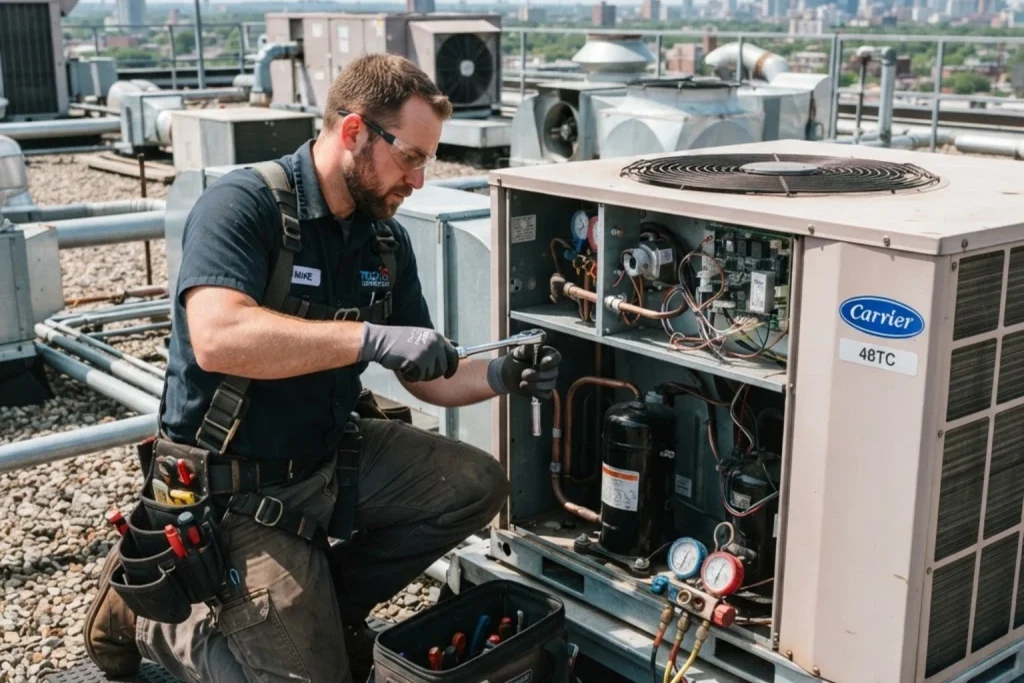
A crew replaces a furnace in a Rochester duplex. A few weeks later, a condensate line fails, soaking the ceiling below, and the homeowner’s insurer sends the contractor a bill. General liability will likely cover the resulting water damage, but it won’t pay to fix the installation itself. If that moisture turns to mold, the claim becomes vastly more complicated.
That’s the recurring pattern with insurance for HVAC contractors: standard package policies handle the claims you hear about most, while the gaps sit in the claims that are most expensive to get wrong. In New York, those gaps usually include pollution, design errors, stolen equipment, injured subcontractors, and height-related falls under strict Labor Law.
What Insurance for HVAC Contractors Usually Includes
Most HVAC shops rely on three primary policies, each tied to a different kind of call from the field.
- General liability covers the customer from damaged hardwood floors and scorched drywall to trip hazards and post-completion property damage.
- Commercial auto also covers the fleet from primary service trucks to a rented van during peak season.
- Workers’ compensation covers your own crew and protects employees injured on the job which in New York is required as soon as you hire your first employee, alongside statutory disability and paid family leave coverage.
While our guide Keep Your Business Safe with HVAC Contractor Liability Insurance details why every shop needs this foundation, this article picks up where that one stops: addressing the high-cost gaps these core policies leave open.
Pollution: Refrigerants, Carbon Monoxide, and Mold
Standard commercial liability forms typically carry a pollution exclusion, and what counts as a “pollutant” can be broader than contractors expect. HVAC work creates three realistic versions of this exposure: refrigerant released into an occupied space, combustion byproducts like carbon monoxide from a poorly vented gas appliance, and mold tied to moisture from ductwork or drain problems.
Whether a specific claim is covered depends on the exact policy wording and the facts, so don’t assume either way. Contractors pollution liability is the coverage built for these situations, and some liability policies include a limited version of it. Ask which one you have, what the sublimit is, and whether it covers work you’ve already completed, since a carbon monoxide or mold claim can surface months after the job closes.
The refrigerant transition makes this a current question. EPA now caps new residential and light commercial air conditioning and heat pump systems at a global warming potential of 700, with installation compliance dates starting January 1, 2025 for most stationary systems and January 1, 2027 for variable refrigerant flow systems (details can be found on the EPA’s sector restrictions page). If your crews are installing and servicing equipment that uses the new refrigerators, your insurer should know.
Design and Professional Errors
General liability responds to bodily injury and property damage but it rarely covers a client who suffers purely financial losses because of your advice. That may include undersized equipment for the building, load calculations that missed building modification, or a duct layout that never delivered the airflow you promised. Many liability policies also carry a professional services exclusion that makes this explicit.
Professional liability (errors and omissions) fills this exposure by covering financial losses from mistakes in professional work. While essential for design-build and commercial contractors, anyone who recommends a system, specifies equipment, or signs off on performance is giving advice that can be second-guessed. A written commitment promising that a system will hold a building at a certain temperature, or cut energy costs by a set amount, is exactly the kind of statement a dispute gets built around.
This ties directly into the rework limitation: liability forms generally pay for damage your work causes to other people’s property and not the cost of repairing or replacing the work itself. In the duplex example, the ceiling is covered under a general liability claim and the re-brazed line falls entirely on the contractor.
Tools, Equipment, and Materials
A business policy usually covers property at a specified location. As we put it on our inland marine page, standard policies often cover only property at a listed address, with limited protection for smaller tools an employee takes to a nearby job. A contractor’s property lives in a van, on a roof, and in a customer’s basement, none of which are the listed address.
Inland marine coverage follows the equipment. For HVAC businesses it covers diagnostic instruments, recovery machines, brazing and power tools, and (often through an installation floater) materials and equipment waiting to be installed. Theft from vehicles is the most common loss, so check whether your policy requires locked or secured storage before it will pay.
If you also keep a shop or warehouse, commercial property insurance covers the building contents, product inventory, and tools and equipment kept there, and can include income lost while operations are suspended after a fire or similar loss. For a contractor whose trucks can’t roll without a stocked shop, that income piece is easy to overlook until it’s needed.
Subcontractors and the Paper Trail
When the busy season arrives and shops bring on subcontractors, the core risk shifts to the sub’s insurance practices. Under Section 56 of New York’s Workers’ Compensation Law, a contractor who subcontracts work can be held directly liable for compensation owed to a subcontractor’s employee if that sub hasn’t secured proper coverage. An uninsured sub’s injured worker can become your claim, just as an uninsured sub’s field mistake can land on your general liability policy.
Preventing these costly surprises is a matter of process:
- Collect a current Certificate of Insurance (COI) from every subcontractor before work starts, and confirm the policy is active and the limits fit the work.
- Document your insurance requirements in writing, specifying statutory workers’ compensation, liability limits, and additional insured endorsements where appropriate.
- Expect the same from your own clients. General contractors, landlords, and municipalities routinely ask HVAC firms for certificates naming them as additional insured; our COI request page is where those get handled.
You must also read the contract. Service agreements and subcontracts often include indemnification (hold-harmless) clauses that make you responsible for the other party’s losses, including the ones you didn’t cause. Liability policies typically cover some contractually assumed liability but not all of it, so send any agreement that shifts risk onto you to your broker before you sign.
Work at Height in New York
HVAC work often occurs off the ground – rooftop units, attic access, tall ladders. New York’s Labor Law § 240 (commonly known as the Scaffold Law) puts a duty on contractors and building owners to provide safety devices, such as ladders, scaffolding, and hoists, for work on a building. Section § 241, adds strict safety requirements for surrounding work areas.
Courts have long enforced these rules strictly. In practice, if someone falls and proper protection wasn’t in place, the contractor can be held responsible even when the worker made a mistake. Homeowners of one- and two-family houses are exempt when they don’t direct the work, but that exemption doesn’t extend to you.
Falls cause serious injuries, and serious injuries trigger massive claims that quickly blow through the baseline of a general liability limit. That is why roof-heavy HVAC contractors often add an umbrella policy that pays once those limits are used up – a strategy we explain in Commercial Umbrella Insurance: What It Covers and How Much You Need. An umbrella raises your limits but follows the terms of your underlying policy, so it won’t fix the exclusions covered above.
When Your Business Changes, Your Policy Should, Too
Policies are priced and written around what you told the carrier: payroll, revenue, vehicles, and the kind of work you do. A shop that starts taking commercial rooftop work, adds a second truck, hires its first technicians, or begins installing a new refrigerant class has changed the risk, whether or not the policy has. Mid-term adjustments are normal, and they’re far cheaper than finding out at claim time that the work wasn’t described.
One more item that gets filed under insurance and isn’t: contractor bonds. A bond is a legally enforceable agreement among three parties that guarantees the contractor will perform the work. It protects the client, not your balance sheet, and it doesn’t replace any policy discussed here.
How to Find the Gaps in Your Own Policy
You don’t need a law degree to audit your coverage. You need the actual documents and a clear description of your work.
- Ask for the full policy and endorsements, not just the certificate or declarations page.
- Read the exclusions, particularly the pollution exclusion, the professional services exclusion, and any conditions on subcontracted work.
- Compare the described operations to what your crews really do, including residential versus commercial and any new equipment types.
- Check your limits against your contracts, since many clients require minimums higher than the policy default.
- Do it before renewal rather than after. Our Q4 renewal guide walks through that timeline.
Frequently Asked Questions
What insurance is required for HVAC contractors in New York?
If you have employees, workers’ compensation is required in New York, as is statutory disability and paid family leave coverage. Commercial auto liability applies to your vehicles. General liability isn’t required for every contractor by state law, but clients, landlords, and municipalities often require it, and local licensing rules vary, so confirm with the city or town where you work.
Do I need pollution liability if I only do residential work?
Possibly. Residential jobs involve the same refrigerants, combustion appliances, and moisture problems as commercial ones, and homes are where occupants spend the most time near the equipment. The question is whether your general liability policy excludes pollution claims, and how.
Are contractor bonds the same as insurance?
No. A bond guarantees performance to the client and can require you to reimburse the surety if it pays out. Insurance responds to claims against you.
Can a certificate of insurance change what my policy covers?
No. A certificate reports what a policy provides; it doesn’t expand it. If a client needs additional insured status or specific limits, those need to be built into the policy itself.
How much does insurance for HVAC contractors cost?
It depends on payroll, revenue, vehicles, the type of work, your claims history, and the limits you choose. Because those details drive the price, a quote based on your actual operations is more useful than any average.
Next Steps for HVAC Contractors
The three standard policies are the foundation of insurance for HVAC contractors, and they leave the highest-cost situations to endorsements, specialty coverage, and good paperwork. Pollution, professional errors, equipment, subcontractors, and work at height are the places to look first.
If you want a second set of eyes on yours, our team can compare your current policies to the work your crews actually do. Learn more about HVAC contractor insurance through The Feltner Group, or get a free consultation.